HMRC published its annual R&D tax relief statistics this week, and the headline is stark: 40,325 claims for the 2024-25 financial year, down 17% on the year before. That is around eight thousand fewer claims than the year before.
The figure will be used by a lot of people this month to argue a lot of different things. It is worth being careful with it, because the same release contains a second number that points the other way: the total relief claimed went up, to £8.2 billion from £7.8 billion. Qualifying expenditure rose 7%, to £51.0 billion.
Fewer claimants. More money. The average claim is up 27% in a single year.
That combination is the whole story, and it is not the story of a scheme being shut down.
What the numbers say
| FY 2023-24 | FY 2024-25 | Change | |
|---|---|---|---|
| Claims | 48,625 | 40,325 | −17% |
| Relief claimed | £7.8bn | £8.2bn | +5% |
| Qualifying expenditure | — | £51.0bn | +7% |
The distribution underneath those totals has shifted decisively toward larger claimants.
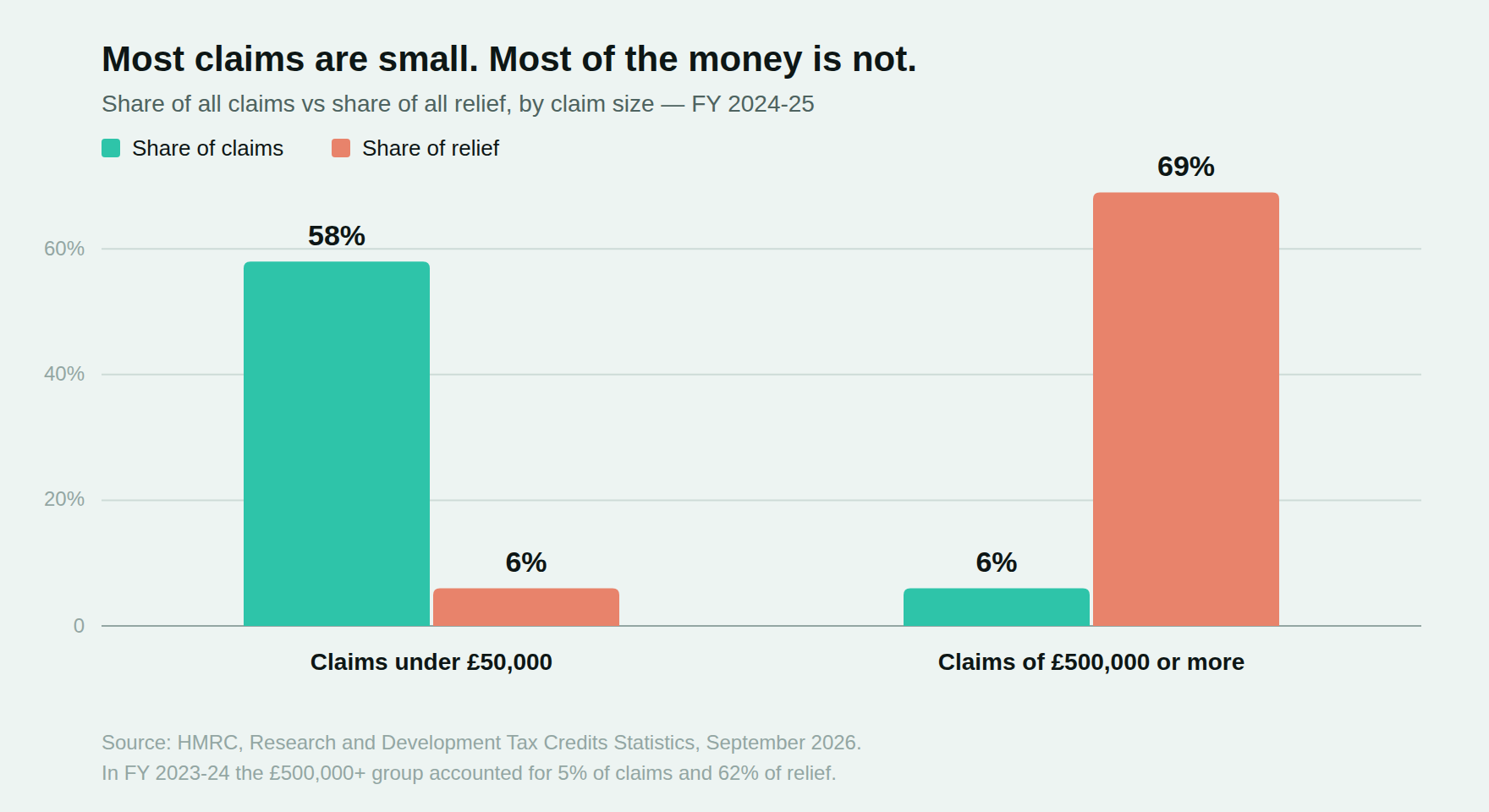
Claims of £500,000 and above accounted for 69% of all relief paid, up from 62% the year before, while making up 6% of claims. At the other end, 58% of claims were under £50,000 and, between them, accounted for 6% of the money.
The companies leaving the scheme are overwhelmingly the small ones.
The number nobody is quoting
The claim-volume figure is dramatic, but the more revealing number sits further down the release: first-time applicants to the SME scheme fell 53%, to 3,405. RDEC first-timers fell 8%. It is the fifth consecutive year that first-time applications have fallen.
These are companies with no history in the scheme, no incumbent adviser, and no prior claim to defend. They are the pure signal of how attractive the regime looks to someone approaching it fresh. And that signal has been negative for five years running.
(These first-time figures are for 2023-24 — they run a year behind the headline claim count, because HMRC needs a full filing cycle to be confident a company is genuinely new.)
Why it happened
HMRC’s own explanation is admirably direct. The release says: “A key driver of the decrease is believed to be the continuing impact of the additional information form.”
The AIF became mandatory for every claim submitted from 8 August 2023. It requires a named company officer to sign off, a named agent to be disclosed, and project-level narrative and cost breakdowns to be filed before the return. In practice, it did three things at once:
It killed the volume claim. A business model that depended on filing a large number of thin claims cheaply stopped working when every claim required a specific project description and a director’s signature. Several of the firms built on that model have exited the market or been wound up. Their clients mostly did not find a replacement adviser — they simply stopped claiming.
It made marginal claims visible before they were paid. Under the old process, a weak claim was often paid first and questioned later, if at all. Now the weakness is legible on the face of the submission. A fair number of companies, shown what they would have to write down and sign, concluded they would rather not.
It raised the cost floor. Preparing a defensible claim properly takes real time. On a £15,000 claim, that work is hard to justify for either the company or the adviser. The 58%-of-claims-but-6%-of-value band is where that maths bites hardest, and it is exactly the band that is emptying out.
The part most commentary gets wrong
There is a version of this article, and you will see several of them this month, that reads: HMRC is unfairly blocking legitimate claims, innovation is being strangled, call us before it’s too late.
That version is not honest, and it is not in your interest.
Some of the decline is the scheme working correctly. The pre-2023 regime paid out on a significant volume of claims that should never have been made — activity dressed up as R&D by advisers on contingent fees, signed off by directors who did not read what was submitted in their name. HMRC’s separately published error and fraud estimates for those years were high enough to make the point hard to argue with. A regime that removes those claims is a regime doing its job, and the companies that lost that “relief” are not victims.
But some of the decline is not that. It is genuine R&D going unclaimed by companies that are eligible, have real qualifying activity, and have concluded the process is too risky or too much trouble. That is a real loss — to those businesses and to the policy. The 53% collapse in first-time applicants is where that shows up most clearly, because it is not companies being deterred by a bad experience; it is companies never starting.
Both things are true at once. Anyone selling you only one of them is selling you something.
What to take from it if you run a company
If you stopped claiming, work out which reason applies. If your old claim was assembled by a firm that rang you up and told you your ordinary business activity qualified, stopping was the right outcome. If you stopped because the paperwork got harder and nobody walked you through it, you have probably left money on the table, and it is worth a second look.
If you are claiming, expect the scrutiny to stay. The statistics do not include any assessment of error and fraud — HMRC deals with that separately — but the direction of travel in the compliance approach has been consistent for four years. A claim that would survive an enquiry today needs contemporaneous records of what technological uncertainty you faced and why a competent professional could not readily resolve it. Not a narrative written eighteen months later from memory.
If you have never claimed and you develop things, the case for looking is stronger now, not weaker. The field has thinned considerably. The relief per claim is at a record high. What has gone up is the standard of evidence, not the difficulty of qualifying.
One caution on the headline
Last year’s release put 2023-24 at 46,950 claims. This year’s puts it at 48,625 — revised up by around 1,700 as late filings landed. The 2024-25 figure of 40,325 will almost certainly be revised up in the same way next September.
So the real fall is probably somewhat less than 17% — and it follows a 26% fall the year before, which is the steeper of the two. This is the second year of a contraction, not the first. Worth knowing before anyone quotes the number at you as settled fact.
Vantage R&D advises UK companies on R&D tax relief claims and defends them when HMRC opens an enquiry. If you want a straight answer on whether your activity qualifies — including “no” — get in touch.
Source: HMRC, Research and Development Tax Credits Statistics: September 2026.