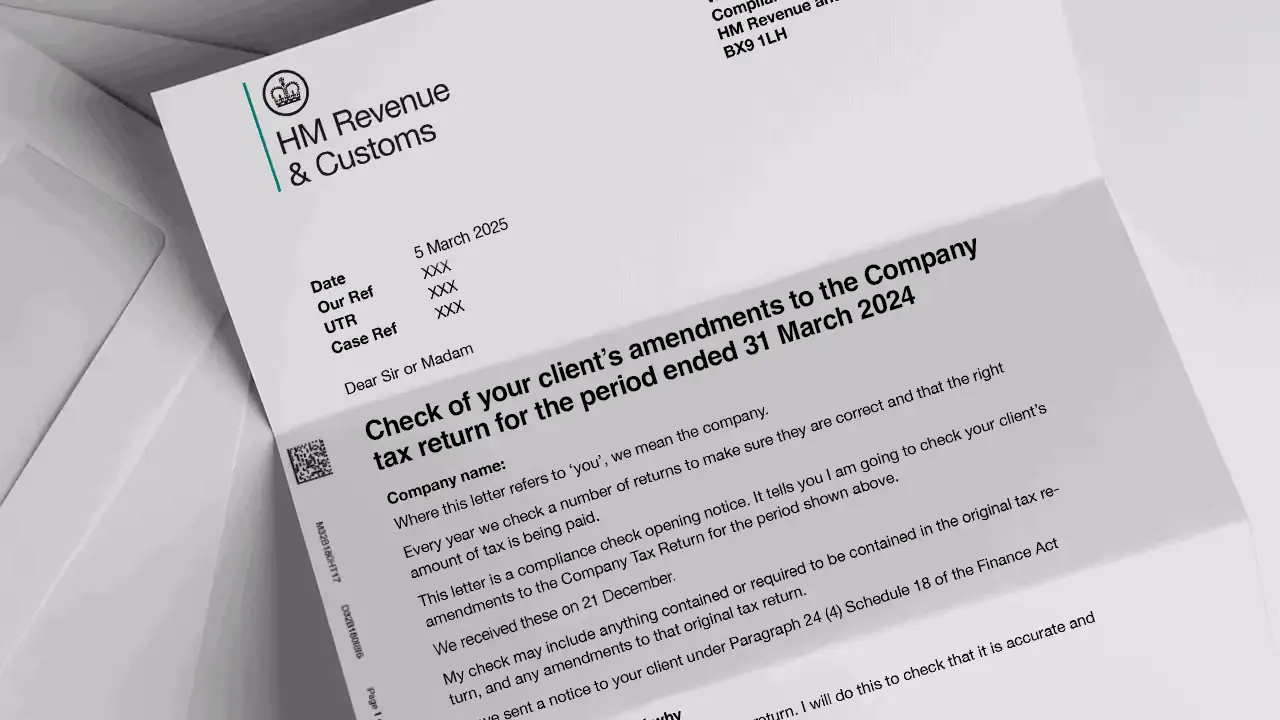
An HMRC compliance check letter for an R&D tax claim almost always arrives at an inconvenient moment. It lands in the middle of a build week or the day before a board meeting, written in language that’s both formal and vague. The first reaction in most businesses is the same: a jolt of alarm, followed by a scramble to work out what has gone wrong. Here is the first point. A compliance check is not an accusation of wrongdoing. It is HMRC opening an enquiry into a return, and R&D claims are currently being opened at a much higher rate than five years ago — including claims that are entirely sound. What happens next depends far less on the letter itself and far more on how you respond.
Understand what the letter actually is
A compliance check letter is a formal notice, usually issued under Schedule 18 of the Finance Act 1998, that HMRC is enquiring into a Corporation Tax return. It will normally set out three things: the accounting period under review, a list of questions or information requests, and a deadline for your response — typically 30 days from the date of the letter. Read it slowly and read it twice. The questions are rarely random. They indicate where HMRC’s attention lies, and in R&D enquiries they tend to cluster around a few themes: whether you sought a genuine advance in science or technology, what the technological uncertainties were, who the competent professionals were, and how the claimed costs relate to the qualifying activity.
Check the deadline — and ask for more time if you need it
The 30-day window is a starting point, not an immovable one. If the period under enquiry is several years old, the people who did the work have moved on, or your technical lead is genuinely unavailable, you can ask HMRC for an extension. Requests made early, politely, and with a clear reason are usually granted. Requests made on day 29 are not. Never let the deadline pass without a response. Non-response is one of the few things that reliably escalates an enquiry.
Resist the urge to reply immediately
The most damaging responses we see are the quick ones. A director, wanting to be helpful, writes a long email the same afternoon, describing the projects from memory. Six weeks later, a properly evidenced response contradicts something in that email, and the enquiry is now about the inconsistency rather than the claim. Everything you send becomes part of the record. Acknowledge the letter, confirm that you are preparing a response, and then take the time to prepare it properly.
Work out what HMRC is really asking
Compliance check questions are often broader than necessary. “Please explain the scientific or technological advance sought” is not an invitation to describe your product. It asks you to identify where existing knowledge in your field ran out and what you did about it. Translating the questions into what they are actually testing is where most of the value in enquiry work lies. Answer the question you were asked, not the one you wish you had been asked, and not a commercial description of a successful project.
Gather the evidence that existed at the time
Contemporaneous evidence carries far more weight than a narrative written after the event. Before you draft anything, pull together:
- Design records, test logs, failed iterations and rig data
- Meeting notes, technical emails and change requests showing decisions being made
- Timesheets or a defensible basis for how staff time was apportioned
- Invoices and contracts for subcontractors, EPWs and consumables
- CVs or role summaries for the competent professionals involved
Failed experiments are not a weakness in a claim. They are often the strongest evidence that genuine uncertainty existed, because nobody iterates through five failed approaches to a problem that was already solved.
Get the competent professional in the room
HMRC is testing technical judgement, which belongs to the engineer, developer, or scientist who did the work — not the finance director or an adviser writing from a template. If your original claim was prepared without meaningful input from that person, the enquiry is where that gap shows. An enquiry response should sound as if it were written by someone who understands the technology, because in a well-run process it largely was.
What not to do
- Don’t withdraw or amend the claim reflexively. A well-founded claim is defensible; withdrawing a sound claim under pressure costs real money.
- Don’t send everything you have. Volume isn’t evidence. A 200-page dump invites more questions, not fewer.
- Don’t assume your original adviser will handle it. Some volume firms are hard to reach once an enquiry is open. You can bring in a specialist at any point, including mid-enquiry.
- Don’t treat it as a tax exercise. R&D enquiries are technical arguments that happen to have tax consequences.
How we approach enquiries at Vantage
We regularly handle compliance checks, including those for claims we did not prepare. The process is consistent: we read the letter carefully, review what was originally submitted, consult the technical team, assess whether the claim is genuinely defensible, and then build a response based on the evidence rather than on assertions. If any part of a claim does not hold up, we will tell you early and plainly. That honesty usually protects the rest. And if you have a compliance check letter in front of you right now, John will record a short Loom video giving you an honest read on where you stand — no charge and no sales pitch.
A final word
A compliance check is a process, not a verdict. Companies that respond calmly, on time, with evidence and with their technical people involved tend to come through intact. Companies that panic, over-share or go quiet tend not to.
Ready to talk it through?
Book a no-obligation call with John or Jason: www.vantagernd.co.uk/book Or send us a brief overview of your projects for a free Loom video review: www.vantagernd.co.uk/review-your-project